
Quick answer
Signature sushi is the creative version of sushi: it starts from classic Japanese technique, but the chef reinterprets it with their own ingredients, sauces, and presentations. Traditional sushi seeks the purity of the product; signature sushi seeks to tell an idea. It is not “better” or “worse”: they are two different philosophies.
Want to try the signature version? At Oni Nikkei we make sushi in Medellín with Japanese-Peruvian roots and our own stamp.
If you have ever ordered a roll with a flame-searing that tasted like salted caramel, a citrus reduction on top, or a combination of flavors you did not expect, you probably tried signature sushi without knowing it. This term comes up more and more on menus in Medellin, but it is rarely explained well what it means and how it differs from everyday sushi.
In this guide we tell you what signature sushi is, how it stands apart from traditional sushi, what techniques and ingredients define it, and how to choose based on what you are looking for that night.
What exactly is signature sushi?
Signature sushi is the creative and personal version of sushi. Instead of sticking to classic recipes and combinations, the chef starts from Japanese technique (the vinegared rice, the precise cut of the fish, the balance of flavors) and uses it as a starting point to create pieces with their own stamp.
That means bringing in ingredients that do not belong to the Japanese canon, playing with sauces, textures, and temperatures, and offering presentations that surprise. The key word is intention: every piece of signature sushi is meant to convey an idea from the chef, not just to replicate a formula that already exists.
How does it differ from traditional sushi?
Traditional (or classic) sushi pursues an ideal of purity. The sushi master, the itamae, spends years perfecting the rice, the cut of the fish, and the exact proportion of each bite. The goal is for the product to shine on its own, with the least possible intervention: a good tuna nigiri is memorable precisely because nothing is left over.
Signature sushi, on the other hand, does not fear intervention. It adds layers of flavor, contrasts, and unexpected elements to build a new experience. Where the traditional says “less is more”, the signature responds “it depends on the story I want to tell”. Both demand technique and respect for the product: the difference lies in creative freedom.
A good signature sushi does not pile up ingredients to impress. Creativity makes sense when each element brings something: an acidic touch that refreshes, a smokiness that adds depth, a texture that surprises. If the fish disappears under five sauces, it is not signature, it is noise.
What techniques and ingredients define signature sushi?
This is where the chef unfolds their stamp. These are some of the most common tools of signature sushi:
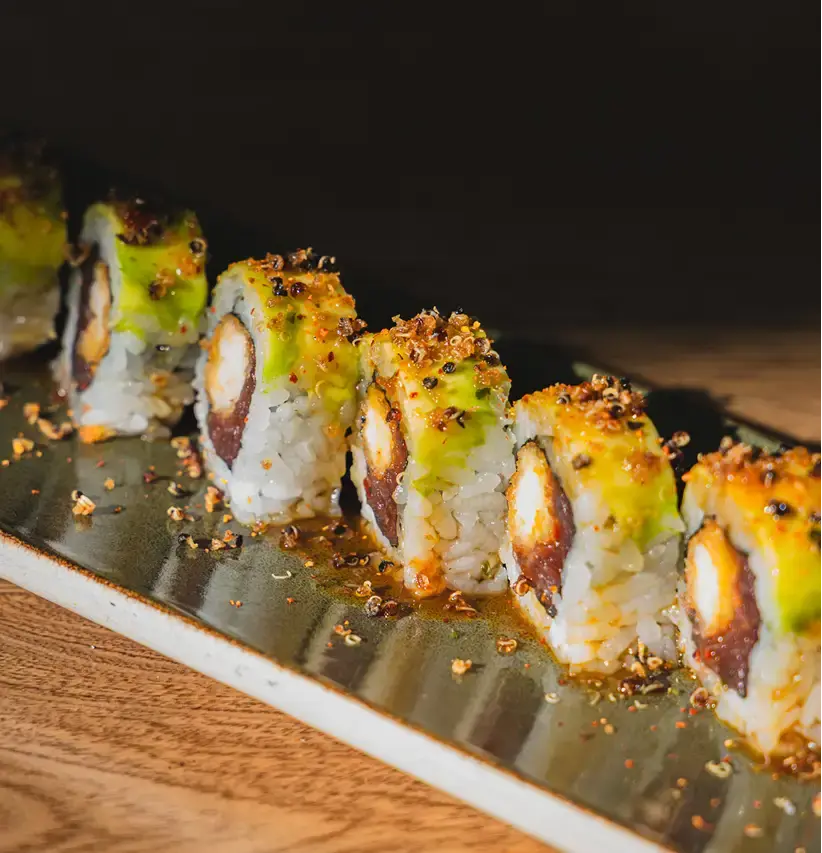
- Flame-searing (aburi). Searing the surface of the fish with a torch to add a smoky note and gently melt the fat. It completely changes the aroma and texture.
- Sauces and reductions. Eel, yellow chili, reduced citrus, spiced mayonnaise, or truffle touches that are brushed on or placed with precision.
- Local ingredients. In a nikkei kitchen, chili, lime, red onion, or rocoto come in, dialoguing with the Japanese base.
- Contrasting textures. Tempura crisps, toasted seeds, or fried chives that break the softness of the rice and fish.
- Presentation as part of the dish. The plating, the color, and even the smoke are part of the proposal.
Try signature sushi at Oni
Flame-seared nigiri, signature rolls, and that Japanese-Peruvian fusion you only understand by tasting it, in El Poblado.
Book your tableHow to compare signature sushi and traditional sushi?
To choose with judgment, it helps to see the differences side by side. Neither column is “the right one”: each responds to a different moment.
| Feature | Traditional sushi | Signature sushi |
|---|---|---|
| Philosophy | Purity and respect for the product | Creativity and the chef’s stamp |
| Ingredients | Classic Japanese canon | Adds local and fusion ingredients |
| Sauces and touches | Minimal (soy, wasabi) | Reductions, flame-searing, contrasts |
| Presentation | Sober and essential | Elaborate, part of the experience |
| When to choose it | When you want the flawless classic | When you want to explore and be surprised |
In short: the traditional gives you the certainty of the well-made classic; the signature invites you to explore and discover combinations you had not tried.
Which one to choose based on what you want?
- If you want the flawless classic Go for traditional sashimi and nigiri. It is the best way to appreciate the quality of the fish and the hand of the cook.
- If you come to explore Order the house signature rolls and nigiri. That is where the chef stamp and the combinations you will not find elsewhere are.
- If you come in a group Combine both worlds: a few classic pieces to start and several signature ones to share and comment on.
Frequently asked questions
Is signature sushi better than traditional sushi?
It is not a question of better or worse, but of intention. Traditional sushi seeks the purity of the product and the perfection of the essential; the signature seeks the creativity and the chef stamp. Both require technique and good product. The ideal is to try both and choose based on the moment and the urge to explore.
Does signature sushi always carry strange ingredients?
Not necessarily. Signature sushi is not defined by how exotic its ingredients are, but by the personal vision of the chef. Sometimes the stamp is in a sauce, in a flame-searing, or in a contrast of textures, more than in a strange ingredient. The key is that each element has a reason to be there.
What relationship does signature sushi have with nikkei cuisine?
Nikkei cuisine, which fuses Japanese technique and Peruvian flavor, is natural ground for signature sushi: it brings ingredients such as chili, lime, and red onion that reinterpret the classic. At Oni Nikkei we work precisely at that intersection between Japanese technique and our own stamp.
Where can I try signature sushi in Medellin?
At Oni Nikkei, in El Poblado, we make signature sushi with Japanese-Peruvian roots: flame-seared nigiri, signature rolls, and tiraditos that play with the acidic and the umami. You can book your table online and enjoy the full experience.
In short
- Signature sushi is the creative and personal version of sushi.
- The traditional seeks the purity of the product; the signature, the chef stamp.
- It relies on flame-searing, sauces, local ingredients, and contrasting textures.
- There is no better one: choose based on whether you want the classic or to explore.